

One Preventable Vet Visit Costs More Than a Year of Knowing Better
Peer-reviewed husbandry protocols translated into practical care guides — so your family learns the science before the symptoms show up.
See What's InsideWe called exotic vet clinics across San Diego.
Here's what preventable conditions cost to treat — conditions that proper husbandry avoids in the first place.
The Research Library gives you the protocols that prevent these conditions — sourced from peer-reviewed herpetology, explained for families.
Based on 2024 pricing surveys of exotic veterinary clinics in the San Diego metropolitan area. Costs vary by region.
Content that grows with your understanding.
Every article is written for a specific comprehension level. Start where you are. Go as deep as you want.
- Your gecko isn't lazy — it's thermoregulating. Why activity changes with temperature.
- The gut-loading window pet stores skip. When to feed your insects for maximum nutrition.
- Five warning signs that something is off — and what each one actually means.
- LED vs. fluorescent — one carries photokeratitis risk. Which UV wavelengths your species needs and why.
- Basalt vs. plastic: the thermal physics that determine safe brumation vs. metabolic shutdown.
- How communal sleeping behavior in wild populations challenges "solitary species" assumptions.
- 57.4% of pet reptiles harbor asymptomatic parasites. Five transmission routes most keepers miss.
- The genetic ceiling of feeder insects — CRISPR data, agricultural economics, and what it means for your feeding program.
- UVB dosimetry protocols: Ferguson zones, exposure scheduling, and species-specific photoperiod design.
Start with two free tiers. Go deeper when you're ready.
Foundation and Exploration content is always free. The Research Library unlocks Mastery-tier protocols, updated monthly.
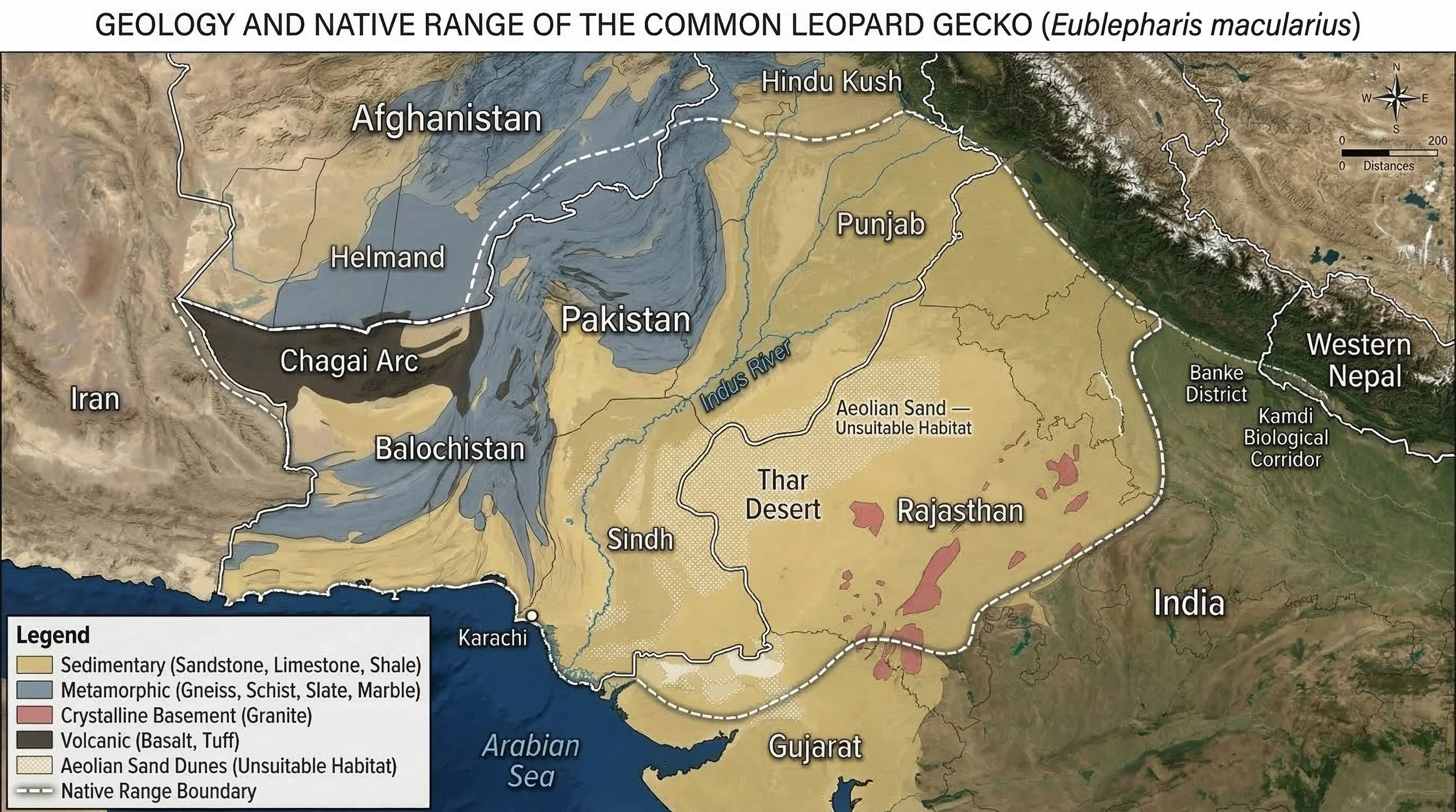
Your gecko's habitat connects to real places, real geology, real science.
Leopard geckos range across Pakistan, Afghanistan, northwestern India, and into Nepal. Their biology tells the story of a landscape — volcanic basalt in the Chagai Arc, metamorphic rock through the Hindu Kush, seasonal extremes shaped by millennia of geological pressure.
The map to the right is original Mimic Habitat research. For families, the enclosure becomes a hands-on gateway to geography, geology, and ecology. Every design choice has a reason rooted in a real place.
Have questions? Read our FAQ