

The 250-Million-Year Divorce
The Deep Dive
The separation was not about "better" versus "worse." It was a biological fork in the road during the late Permian period, approximately 254.7 million years ago (Ezcurra et al., 2014). One path led toward dinosaurs. The other led toward modern lizards. Both paths started from the same kind of animal — diapsid reptiles, identified by a specific "two-hole" skull structure behind the eye socket.
That fork produced two branches with formal names. The archosaur branch ("ruling reptile forms") eventually gave rise to dinosaurs, pterosaurs, crocodilians, and birds. The lepidosaur branch ("scaled reptile forms") gave rise to tuataras, lizards, snakes, and amphisbaenians. Think of it like a highway splitting at an interchange 250 million years ago. Every vehicle that took the left exit ended up in archosaur territory. Every vehicle that took the right exit ended up in lepidosaur territory. No U-turns were possible.

254.7 million years ago, one lineage became two. The left path leads to dinosaurs. The right leads to your terrarium.
The archosaur branch is defined today as a crown group containing the most recent common ancestor of living birds and crocodilians, plus all of its descendants. That means birds and crocodilians are each other's closest living relatives. Every dinosaur, every pterosaur, every T. rex and Triceratops falls within this branch. The living members are limited to two groups: roughly 10,000 bird species and 27 crocodilian species.
The lepidosaur branch took a different path entirely. Its oldest definitive fossils appear in the Middle Triassic, around 244 million years ago. This branch eventually produced the Squamata — the order containing all lizards, snakes, and amphisbaenians. It also produced the Rhynchocephalia, a group once diverse across the Mesozoic but now represented by a single species: the tuatara (Sphenodon punctatus) of New Zealand. Squamata alone accounts for more than 11,000 living species, making it the most species-rich order of non-avian reptiles on Earth (Zheng & Wiens, 2016).
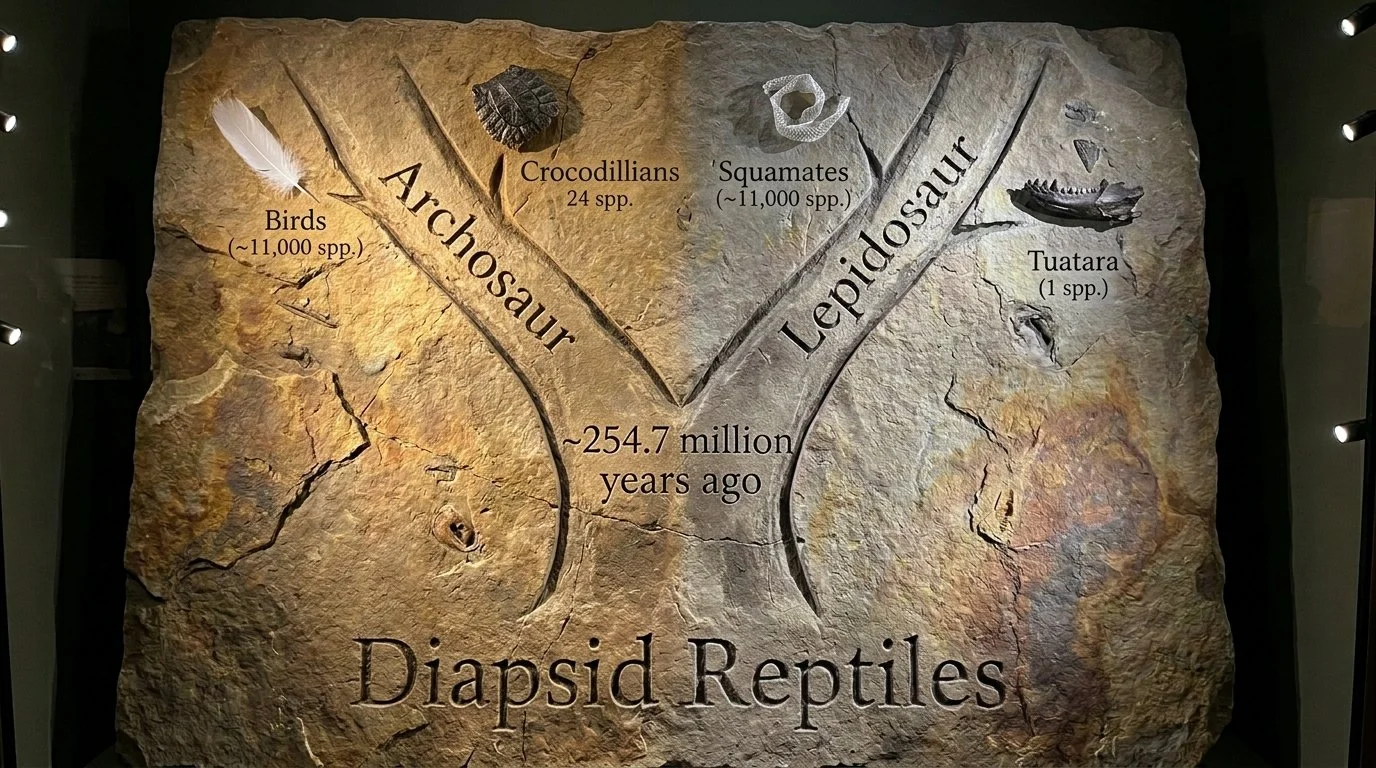
The archosaur branch carries a dinosaur fossil on its trunk — but the path continues past it to feathers and scutes. Birds and crocodilians are the only living members. The lepidosaur branch, with shed skin and ancient jaws, leads somewhere else entirely.
This framework dissolves several persistent myths in the reptile hobby. Bearded dragons (Pogona vitticeps) belong to the family Agamidae, whose oldest unambiguous fossil dates to approximately 99 million years ago. Leopard geckos (Eublepharis macularius) belong to the gecko lineage, with fossils reaching back roughly 100 million years. Both families diversified well after the fork occurred. These are geologically young species within an ancient lineage — and that lineage was never on the dinosaur branch.
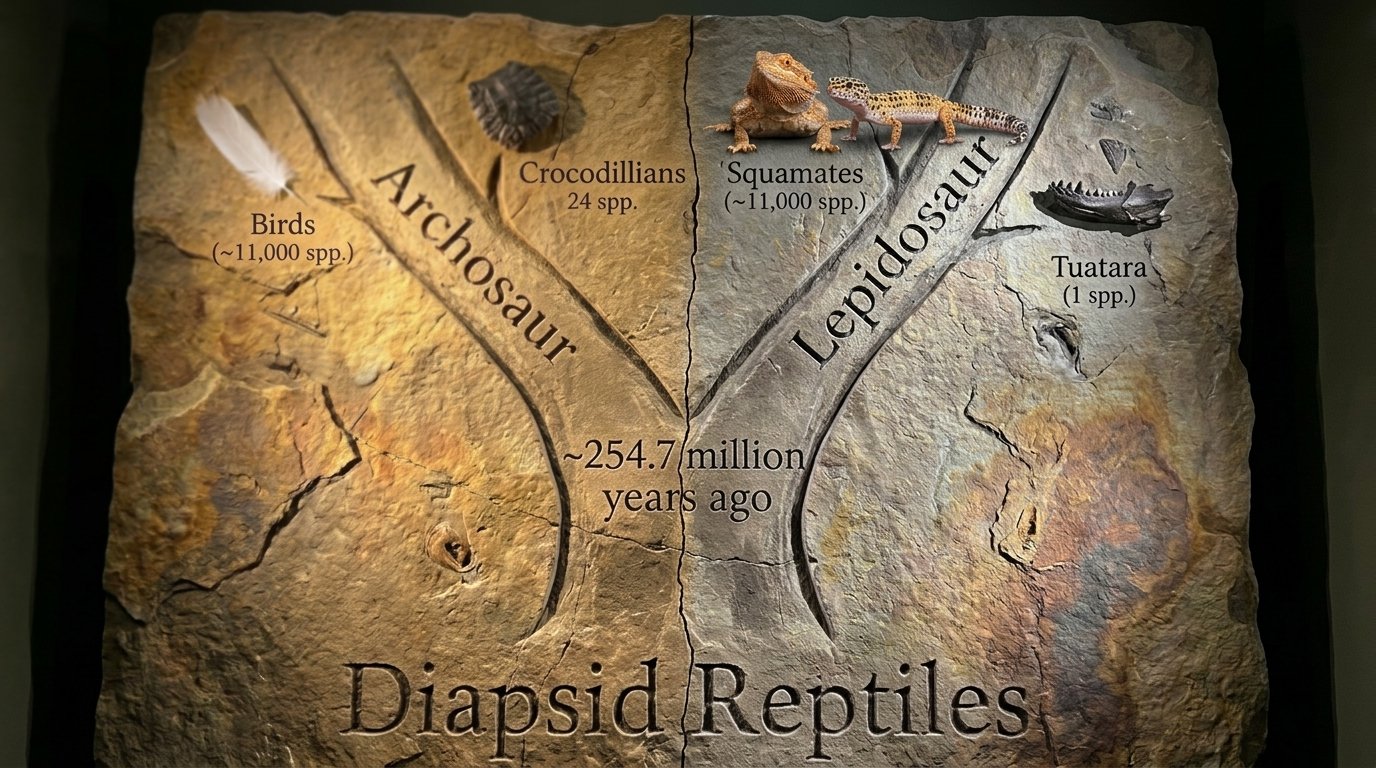
Bearded dragons and leopard geckos are squamates — the same branch as snakes and all other lizards. They sit at the tip of the lepidosaur lineage, over 250 million years of separate evolution from anything on the dinosaur side.
The Pattern Recognition
Once the fork is understood, patterns emerge that explain otherwise puzzling differences between the two branches.
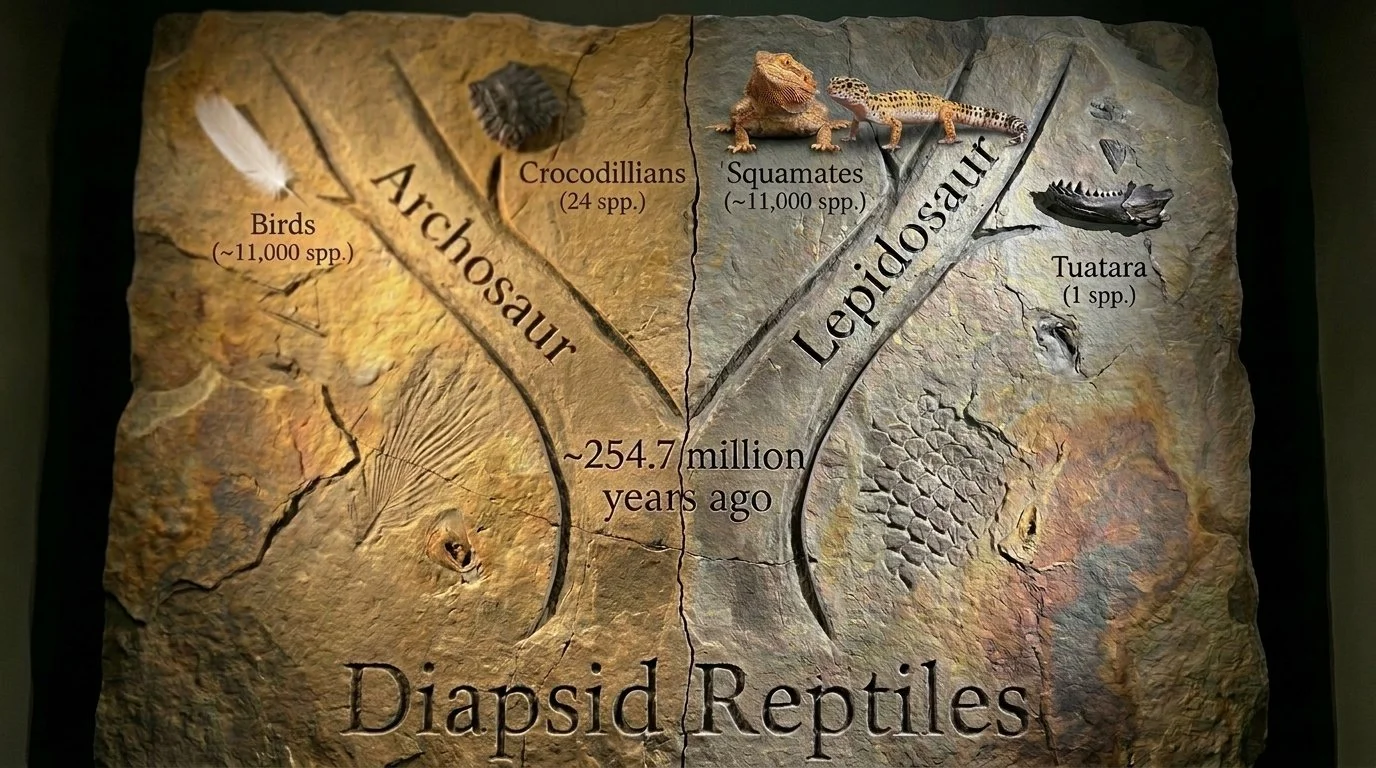
Feathers evolved on the left branch after the fork. The shedding cycle evolved on the right. Your lizard's ecdysis is not a dinosaur holdover — it is a lepidosaur innovation with its own quarter-billion-year history
Why dinosaurs had feathers and your lizard does not.
Feathers appear to have originated within the archosaur lineage, likely as simple filamentous structures used for insulation in the Early Triassic, when both archosaurs and synapsids (the ancestors of mammals) were evolving higher metabolic rates and more erect gaits (Benton, 2019). Feather-like structures have been found in both dinosaurs and pterosaurs, suggesting feathers may predate the dinosaur-pterosaur split and originated in a common archosaurian ancestor perhaps 250 million years ago. Lepidosaurs had already diverged from this lineage before feathers evolved. They developed a fundamentally different integumentary strategy: overlapping keratinized scales that are shed collectively through ecdysis — a process unique to lepidosaurs among reptiles (Maderson, 1966). Crocodilians, despite being archosaurs, possess beta-keratin proteins similar to those in bird feathers, hinting at shared genetic heritage. Lizards lack the full suite of genes required for feather formation.
Whether dinosaurs shed like modern pet reptiles.
The short answer is almost certainly not in the same way. Lepidosaurs shed their outer epidermal generation in coordinated episodes — geckos slough large patches, snakes shed in a single piece. This synchronized shedding cycle involves six distinct stages and serves functions including repairing the attachment system in pad-bearing geckos (Pillai et al., 2023) and restoring barrier function against water loss. Archosaurs, by contrast, developed scutes — thick, non-overlapping keratinized plates. Crocodilians grow and replace individual scutes gradually rather than shedding synchronously. Dinosaurs likely followed a similar pattern. The lepidosaur shedding cycle, including the capacity for ecdysis to repair functional structures like gecko toe pads, represents an innovation specific to that lineage. Your bearded dragon's periodic shedding is not a holdover from dinosaur ancestry. It is a lepidosaur adaptation with its own 250-million-year history.
Are crocodile skinks related to crocodiles?
No. Red-eyed crocodile skinks (Tribolonotus gracilis) belong to the family Scincidae — they are squamate lizards, firmly on the lepidosaur branch. Their common name derives entirely from their rows of keeled, armor-like dorsal scales that superficially resemble crocodilian osteoderms. This resemblance is a textbook example of convergent evolution: two unrelated lineages arriving at similar structural solutions under similar environmental pressures. Crocodile skinks are separated from actual crocodilians by over 250 million years of independent evolution. Their armored scales evolved for protection in the humid rainforest leaf litter of New Guinea. Crocodilian osteoderms evolved for entirely different purposes within the archosaur lineage.
Which living species are the closest to dinosaurs?
Birds. They are not merely "related to" dinosaurs — they are dinosaurs, classified within the theropod clade Maniraptora. Crocodilians are the nearest non-avian living archosaurs and thus the closest non-bird relatives of dinosaurs. No living lizard, gecko, or snake occupies any position on the dinosaur branch. The tuatara is sometimes called a "living fossil," but it sits on the lepidosaur branch alongside lizards and snakes. No non-avian reptile in your terrarium belongs to the archosaur clade that produced dinosaurs.
The Validation
This framework predicts and explains phenomena beyond taxonomy. Consider the K-Pg mass extinction 66 million years ago. The conventional narrative states that an asteroid killed everything on the ground while birds survived in the sky. The reality is more nuanced and more instructive.
Lizards, snakes, crocodilians, mammals, frogs, and salamanders all survived the K-Pg event on the ground. What distinguished survivors from victims was not flight capability — it was body size, metabolic rate, diet, and habitat preference. Ectothermic crocodilians, with their low caloric needs, can survive months without food. Endothermic non-avian dinosaurs of comparable size lacked that metabolic flexibility. Small ground-dwelling birds that could eat seeds cached in soil survived while tree-dwelling birds perished alongside the forests destroyed by global fires (Field et al., 2018). Squamates — already diversified across the lepidosaur branch — persisted because their small size, low metabolic demands, and diverse dietary strategies gave them resilience that massive archosaurs lacked.
The pattern holds across extinction events. Lepidosaurs survived the end-Permian extinction that nearly sterilized the planet. They survived the end-Triassic extinction. They survived the K-Pg event. Squamates then underwent explosive diversification in the Cenozoic, filling ecological niches left vacant by extinct archosaurs. The lizards and snakes alive today are not leftovers from the age of dinosaurs. They are the winners of a parallel evolutionary race that outlasted the competition.
The Application Bridge
This evolutionary context changes how we think about species-specific care. When we understand that a bearded dragon's evolutionary engineering was shaped by 99 million years of agamid diversification in Gondwana — not by dinosaur ancestry — we start asking different questions about habitat design. The thermal strategies, substrate interactions, and behavioral drives of Pogona vitticeps reflect adaptation to specific Australian ecological pressures that have nothing to do with theropod biology.
Similarly, recognizing that leopard geckos carry roughly 100 million years of gecko-specific evolution reframes our understanding of their ecdysis cycle, their nocturnal behavioral patterns, and their substrate requirements. These are not generic "reptile" traits inherited from some vaguely prehistoric past. They are specific adaptations shaped by specific selective pressures within the lepidosaur lineage.
The 2025 Mansfield discovery pushes the amniote origin story even deeper. If clawed tetrapods were walking across Gondwana 355 million years ago, the divergence events that produced modern reptile families occurred against a backdrop far older and more complex than previously modeled. The implications for understanding how current environmental pressures — rising temperatures, shifting humidity zones, habitat fragmentation — affect these ancient lineages require a complete evolutionary framework, not a cartoon version of "lizard descended from dinosaur."
That framework, and the protocols it demands for evidence-based husbandry, is exactly what the research reveals when examined without preconceptions.
